%20(1).svg)


Founded in 2014, Energy Control helps commercial buildings reduce energy consumption through intelligent building automation. By combining data from building systems, sensors and control equipment, the company's platform continuously optimizes heating, ventilation and energy usage while maintaining a healthy indoor climate.
Over the last decade, Energy Control has grown from a small Norwegian startup into one of the country's leading energy technology companies. In 2025, the company was acquired by Noova Energy Systems in a transaction valued at approximately NOK 150 million, while continuing to operate under the Energy Control brand.
Throughout that journey, the company has relied on Linux-based edge infrastructure, deployed across customer sites throughout Norway.
Building an IoT company involves much more than developing a product.
For Energy Control, the mission was always clear: help buildings consume less energy and operate more efficiently. However, delivering that vision required a growing fleet of connected devices installed across customer locations, each of which needed to be monitored, maintained, updated and secured throughout its lifecycle.
Like many IoT startups, the company initially faced a familiar challenge. Every technical requirement seemed to introduce another platform component that could be built internally. Device management, software deployment, remote access and operating system maintenance all demanded engineering resources.
As the company expanded, founder Tommy Hagenes and his team began to recognize that many of these challenges were not unique to Energy Control.
We need to focus on our product instead of building and maintaining the entire stack around it.
That realization became an important turning point in the company's growth journey.
Energy Control built its platform on Linux-based UniPi controllers, giving the company the flexibility to develop its own applications, integrations and optimization logic while maintaining full control over the technology stack.
.png)
The controllers are installed directly in commercial buildings where they communicate with HVAC systems, sensors and technical infrastructure. This allows Energy Control's software to continuously analyze building performance and adjust operations based on real-world conditions rather than fixed schedules.
The openness of the platform gave the company significant freedom during its growth phase. At the same time, it also introduced operational responsibilities. Managing Linux devices at scale requires secure remote access, software updates, configuration management and ongoing lifecycle maintenance.
While these capabilities are essential for operating an IoT business, they were never the reason customers chose Energy Control.
Customers chose Energy Control because they wanted lower energy costs, improved building performance and more sustainable operations.
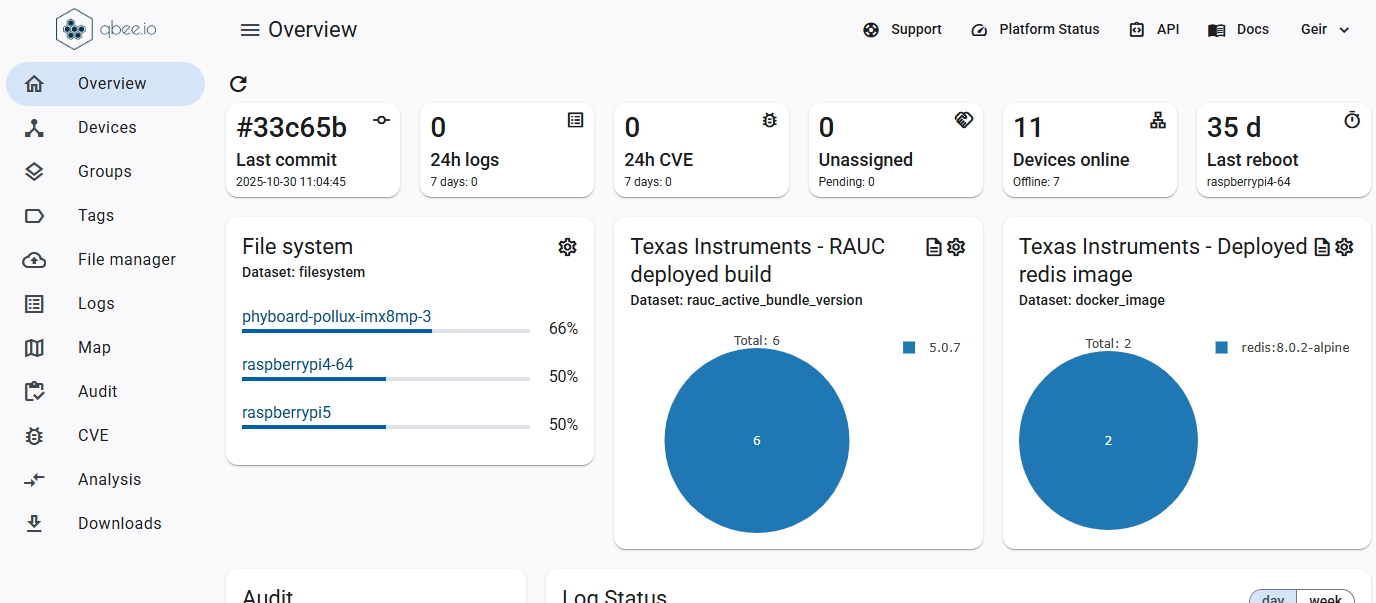
Energy Control has used Qbee from the early stages of its growth journey, but the role of the platform became increasingly important as the company expanded.
According to Hagenes, one of the most important lessons from building an IoT company is understanding which problems should be solved internally and which should be entrusted to specialist partners.
The company realized that device management was not a source of competitive advantage. Rather than building and maintaining its own platform for Linux fleet management, Energy Control chose to leverage a solution that had already been tested across thousands of deployed devices and multiple industries. If a vendor already has thousands of controllers in the field, they already have all the experience we will eventually have. They already have all the same problems.

This perspective fundamentally changed how the company approached its technology stack. Instead of viewing suppliers as software vendors, Energy Control increasingly viewed them as strategic partners.
We need to have a close relationship with our vendors and help them deliver the best software.
By relying on Qbee for device lifecycle management, Energy Control could focus its engineering efforts on the challenges that actually differentiated the company in the market.
One of the benefits Energy Control highlights is the collective experience that comes from using a platform deployed across many different customers and industries.
As more companies solve similar operational challenges, improvements made for one deployment often benefit everyone else using the platform.
For Hagenes, this creates an ecosystem effect that would be difficult for any individual company to replicate internally.
If a vendor in Germany finds a problem, Qbee can introduce new features, and we will share benefits.
Rather than repeatedly solving the same infrastructure challenges, Energy Control could build on lessons already learned by others and concentrate on creating value for building owners.
Over the course of its growth journey, Energy Control successfully scaled its platform across a large portfolio of commercial buildings while maintaining focus on its core mission of energy optimization and building intelligence.
The company's technology now helps customers significantly reduce energy consumption while improving operational efficiency and indoor climate. That success ultimately led to the company's acquisition by Noova Energy Systems in 2025.
Looking back, Hagenes believes one of the most valuable lessons for other IoT startups is the importance of focus.
Many companies attempt to build every component themselves, from hardware and connectivity to fleet management and deployment infrastructure. While this approach can seem attractive in the early stages, it often diverts resources away from the problem customers are actually paying to solve.
For Energy Control, that focus meant concentrating on smarter buildings and better energy management while relying on trusted partners for the surrounding infrastructure.
That decision helped transform a small startup into a company capable of scaling nationally, delivering measurable value to customers and ultimately achieving a successful exit.