The rapid evolution of the Internet of Things (IoT) devices calls for robust systems that can cater to the dynamic needs of the applications. A key aspect of IoT device management is the ability to perform Over-The-Air (OTA) software updates. This article discusses the Yocto Project, its significance in IoT, and how it can be utilized to perform OTA software updates. While Yocto is focusing on full image updates, the qbee agent is able to initiate those but also provides means of doing less risk prone and precise updates by just changing files, binaries, configuration or patching a system library. So we see an increasing number of companies demanding full firmware level OTA update capabilities but with an additional high precision, low risk alternative. This comes also in handy when fleets need to be individualized based on feedback from ERP or third party systems. But let's dive into Yocto.
The Yocto Project is an open-source project that facilitates the creation of custom Linux-based systems irrespective of the hardware architecture. While it's not a Linux distribution itself, it provides a framework and tools to create one. Yocto is particularly valuable for embedded and IoT applications, as it offers the flexibility to customize the operating system tailored for specific needs. The following link explains how to integrate the meta-qbee layer into Yocto.
These 4 topics can be addressed on two different levels. One is the firmware level, meaning that a full image gets updated. The other one can be handled on the OS level with a tool like the qbee agent. This allows to quickly patch libraries or software while waiting for the next image release. In addition, it is of great importance to be able to deploy individual configuration on the devices (license keys, certificates or just parametrization) even for large fleets.
The Yocto Project itself doesn’t provide direct OTA functionality, but there are several tools and frameworks built on top of or alongside Yocto that make OTA feasible.
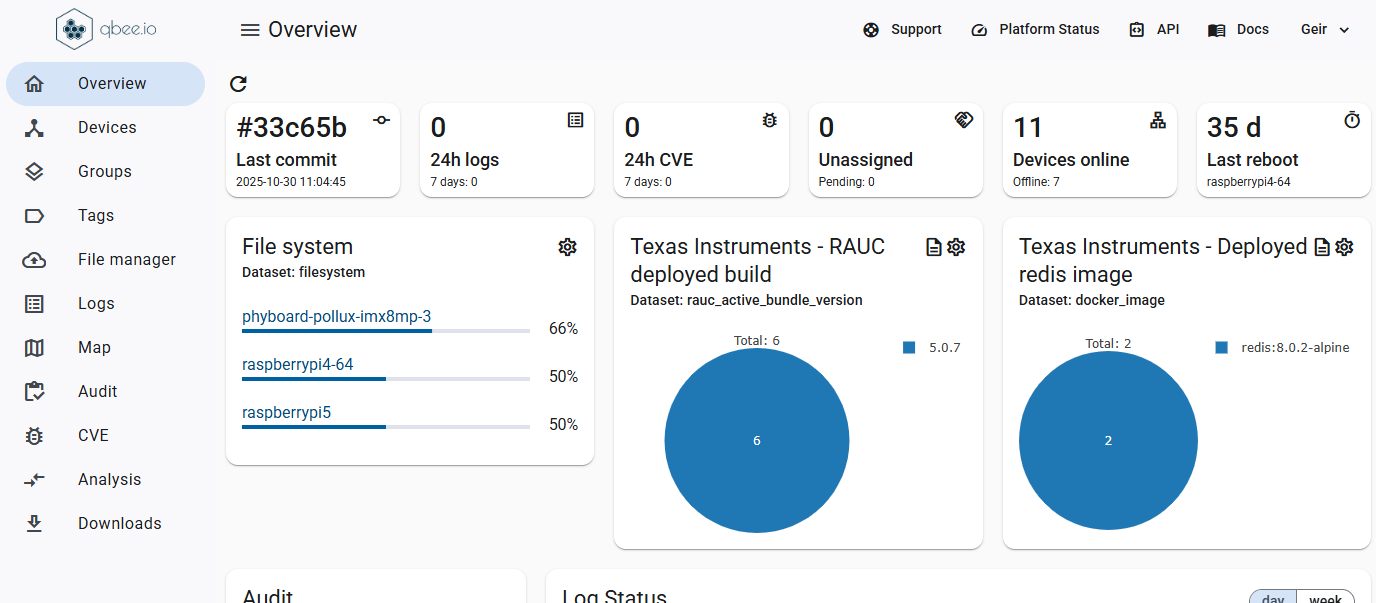
The qbee agent supports Rauc as the update mechanisms. Please reach out to us if you’d like to learn more. You can also consult this detailed guide on how to enable OTA updates with RAUC and qbee.
Leveraging the Yocto Project for IoT projects ensures a lightweight, tailored operating system that's optimized for the specific needs of the device. Integrating OTA capabilities further enhances the value proposition by offering dynamic update possibilities, ensuring security, longevity, and enhanced capabilities for IoT devices. Given the wide range of benefits, it's evident that both Yocto and OTA updates are indispensable for contemporary IoT solutions. If you want the best of both worlds you combine the full firmware updates with a lighter mechanism that can operate in a much more pinpointed way and also introducing parametrization and individualization of the fleet through dynamic, API driven and templated mechanisms. Here we recommend to take a look at qbee.io and the qbee agent that is available as being part of the Yocto layer. In addition, it can be the driving force that initiates the updates, for example with Rauc.