%20(1).svg)
.png)

When developing an embedded Linux device, one of the first architectural decisions is selecting the operating system (OS) distribution. Broadly, there are two approaches. You can build a custom Linux distribution from source using tools such as Yocto or Buildroot, giving you complete control over the software stack and footprint. Alternatively, you can adopt a pre-built binary distribution such as Debian, Ubuntu, or Raspberry Pi OS (Raspbian), which accelerates development by providing a fully packaged operating system with extensive software repositories and long-term maintenance. Each approach involves different trade-offs in customization, maintenance, security, and long-term device management.
When it comes to updating software on embedded Linux devices, over-the-air (OTA) updates are the most efficient and scalable approach, particularly for large-scale deployments where manually updating devices in the field is impractical. To achieve this, a secure end-to-end system architecture is needed to receive, deploy, and manage software updates remotely (see image). To this end, the design splits cleanly into two domains that have almost opposite constraints: the server side, which manages trust, versioning, and rollout at scale, and the client side, which has to survive power loss, flaky networks, and years of unattended operation while still guaranteeing it never boots into a broken or malicious image.
It is important to understand that an OTA update system is designed to secure the software update process, not the physical device as a whole. Its primary responsibility is to ensure that software updates are delivered, verified, and installed securely, protecting against threats such as tampered update packages, unauthorized software, and man-in-the-middle attacks during deployment.
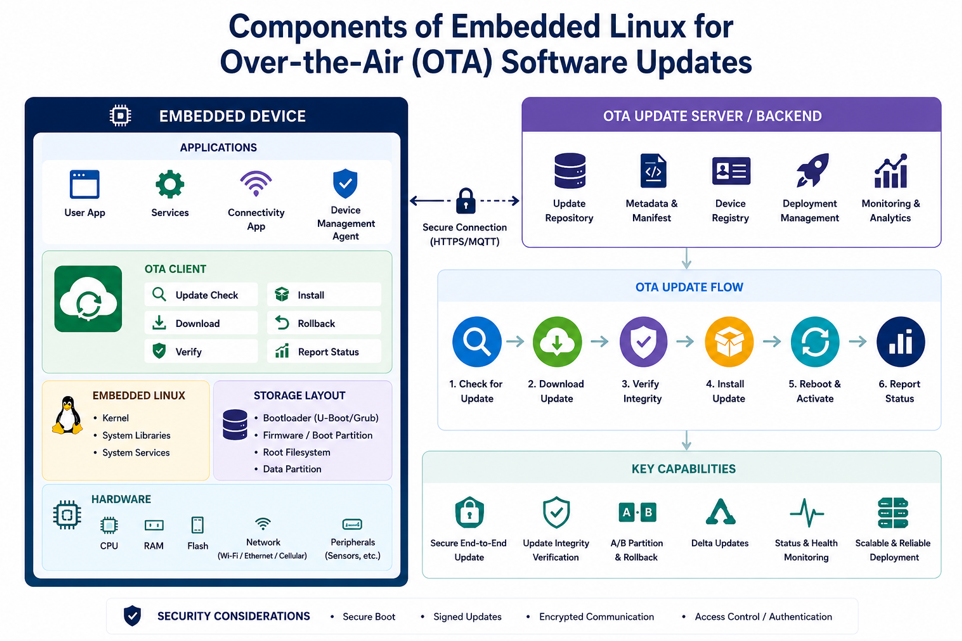
Nearly every embedded Linux device contains a bootloader responsible for starting the system, a Linux kernel that manages hardware resources, a root filesystem that provides the operating system and core services, and one or more additional partitions that store applications, device configurations, persistent data, or firmware. These are the primary software components that an OTA update system must be capable of deploying, managing, and recovering should an update fail. System software updates or also interchangeably called firmware updates primarily refer to these components whereas application software updates refer primarily to any software component at the user space.
It is worth being precise about what gets updated, since the answer changes your architecture:
Whatever you update, the same requirements apply: it must be secure (can't become an attack vector), atomic (all-or-nothing), fail-safe (recoverable), complete (covers every layer that needs it — bootloader, kernel, rootfs, apps), and tuned to your required frequency and speed.
The device-side update agent is the riskiest piece of this whole system, because a bug here can physically brick hardware that's in the field. Two architectural decisions dominate: how you lay out partitions for fallback, and how you chain cryptographic trust from silicon to rootfs.
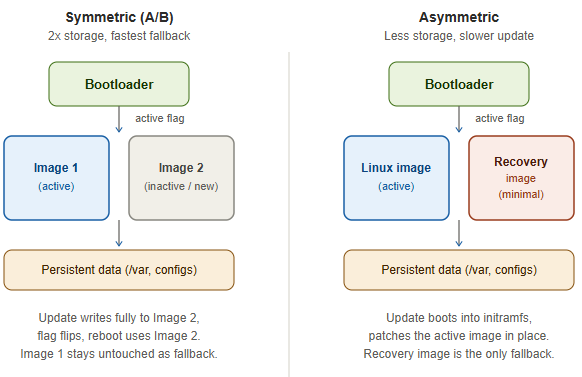
Most fallback-capable designs come down to one of two storage strategies. Symmetric (A/B) duplicates the entire image across two partitions — you write the new version into the inactive slot, flip an "active" flag, and reboot. Asymmetric updates the active image in place (typically by booting into an initramfs and patching from there) and relies on a smaller, separate recovery image as the fallback path. The trade-off is storage versus complexity and recovery speed. A reference diagram for is shown below.
The actual update sequence on a symmetric layout looks like this:
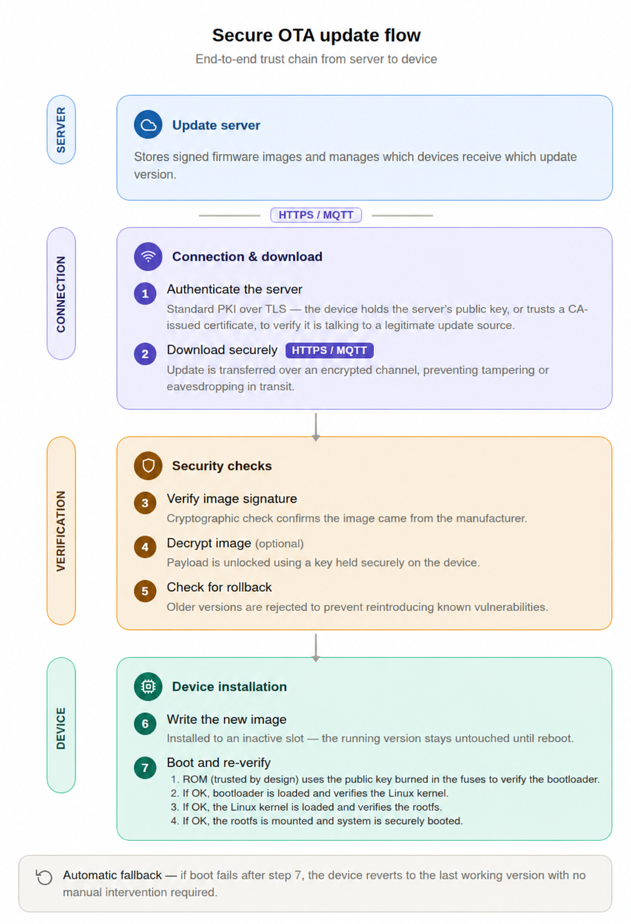
This is the part that actually makes the rest of the system trustworthy. The goal is that no single compromised layer, not even physical access to flash storage can get unsigned code to execute.
A few details worth calling out from the secure OTA update flow diagram below:
For application-level updates specifically, containers (Docker, containerd, runC, cri-o, or lighter embedded options) decouple application lifecycle from OS lifecycle entirely. You get per-container resource limits (CPU, memory, network), the ability to run conflicting library versions side-by-side, and atomic, independently recoverable updates per container — without touching the base OS image at all. The trade-off is that you now need a container runtime baked into your OS image, which is its own maintenance surface.
If the client side is about surviving the update, the server side is about deciding who gets what, when, and proving it's legitimate. The client-side agent serves as the final arbiter of legitimacy within the trust chain. A robust architectural stance dictates that the device should treat the OTA server with the same level of inherent skepticism as an unverified physical peripheral. Consequently, the update client must perform rigorous cryptographic verification of the deployment bundle prior to execution, maintaining a consistent security posture whether the artifacts are delivered via network infrastructure or local storage media.The architectural concerns here are different in kind, not just degree.
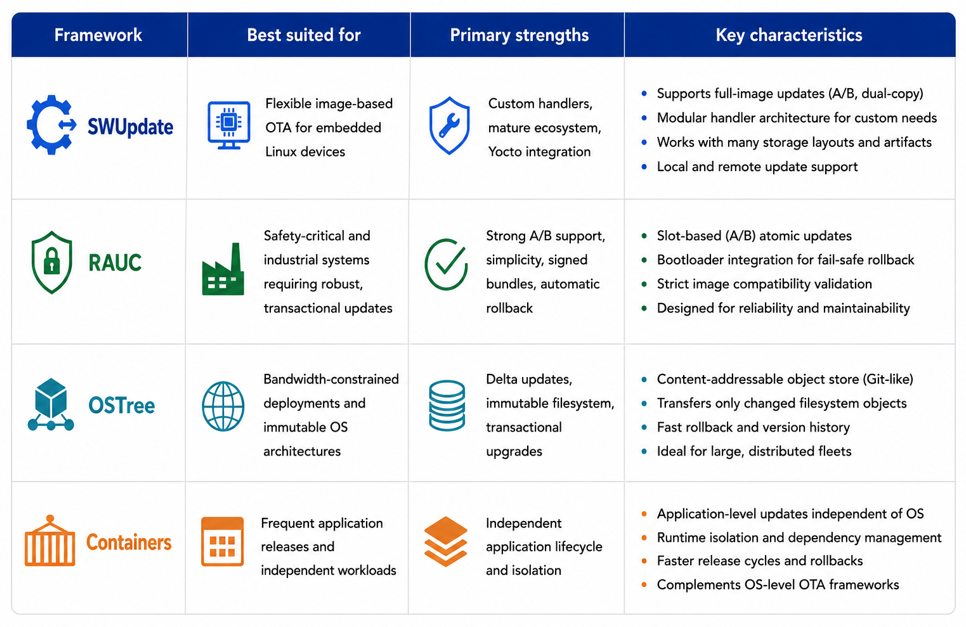
Several mature open-source frameworks support embedded Linux deployments.
SWUpdate is well suited for full-image A/B deployments and integrates tightly with Yocto-based build systems. It provides robust support for signed update bundles, bootloader integration, and atomic installation. It is particularly well suited for:
RAUC is another mature framework and like SWUpdate, it emphasizes robustness, cryptographic verification, and fail-safe recovery. It installs signed update bundles into predefined boot slots and relies on the bootloader to activate the new software only after successful validation. It is built around several key design principles:
OSTree excels when bandwidth optimization and immutable filesystem deployments are priorities. Its Git-inspired object model enables efficient binary delta distribution and rapid rollback. This architecture offers several advantages:
Container-based approaches complement, rather than replace, operating system OTA mechanisms by simplifying application deployment while leaving kernel and platform updates to dedicated OTA frameworks. Container-based deployments provide:
There is no universally "best" OTA framework—only the one that best fits your product architecture and operational requirements. See the comparison table below.
Learn More: OTA Best Practices Checklist
While frameworks like RAUC or SWUpdate provide the mechanisms to handle the delivery of OS updates, Qbee functions as the orchestration and operations layer for the entire fleet. Rather than mandating a specific OTA standard, it serves as a unified control plane that integrates with existing open-source frameworks to manage system, container, and configuration updates across diverse IoT deployments. This framework-agnostic approach is vital for organizations maintaining multiple hardware platforms with varying update requirements. By decoupling the fleet-wide management from the low-level implementation, engineering teams can utilize the optimal update strategy for each device type while maintaining consistent automation and remote access. This flexibility is particularly critical for edge AI environments, where application logic and models iterate much faster than the base OS, allowing for continuous software delivery without the overhead of full system image redeployments.
The client and server only work as a system if they're treated as one trust chain end-to-end: a server with perfect TLS hygiene is irrelevant if the device blindly trusts whatever lands in its inactive partition, and a device with a flawless A/B fallback is still exploitable. All update artifacts must be signed in a trusted environment before being uploaded to any OTA server solution. The practical takeaway is to design the signing and verification path first — server authentication, device authentication, image signing, and the hardware root of trust — and only then pick the layer that fits your bandwidth, storage, and update-frequency constraints.
There is no universally "best" OTA framework. Instead of a one-size-fits-all solution, evaluate each framework based on your device architecture, reliability requirements, and operational needs: how often you update, how much bandwidth is available, how critical rollback is, and how much fleet management functionality you need out of the box.
Avoid restructuring your entire embedded Linux device fleet to accommodate a purpose-built OTA platform. Rather than adopting a vendor-mandated approach, you should select the OTA software update strategy that aligns with your fleet requirements. Qbee integrates seamlessly with established open-source frameworks, containerized environments, and application-level update mechanisms. This allows for the unified management of heterogeneous fleets via a single control plane, effectively eliminating the need for expensive architectural migrations.
Designing OTA infrastructure requires balancing flexibility, reliability, security, storage efficiency, operational complexity, and deployment velocity. The most successful implementations treat OTA as an integral component of the software delivery pipeline rather than an isolated firmware feature.
.png)