%20(1).svg)
.png)

IoT security is uniquely challenging because protection must extend from centralized cloud and data center infrastructures down to distributed edge compute and device layers. Securing massive fleets of remote hardware—from regional gateways and small servers to cameras, sensors, and robots—requires moving beyond traditional IT playbooks toward decentralized monitoring and device AI to manage physical exposure without human oversight. Consequently, a breach in these edge computing environments transforms a digital data problem into an immediate operational crisis, where localized disruptions can swiftly cascade into millions of dollars in damages.
The IoT security landscape has shifted significantly over the last 18–24 months. Security is no longer viewed as a feature; it is increasingly becoming a regulatory, operational, and business requirement. For companies building connected products, especially in industrial IoT, medical devices, robotics, AI-enabled devices, and smart products, several trends have emerged.
The biggest shift is that security is moving from a best practice to a legal requirement.
The EU's Cyber Resilience Act (CRA) requires manufacturers to demonstrate secure development practices, vulnerability management, secure defaults, and ongoing security support throughout the product lifecycle. Similar requirements are appearing in the UK, U.S., and Asia-Pacific markets.
True IoT resilience demands that security requirements become a foundational pillar of product design, transforming threat modeling into a standard engineering practice rather than a post-development afterthought. However, building a secure device is only the first step; security ownership must extend far beyond the initial product launch, shifting the vendor's role from a one-time provider to a long-term operational partner. In today's threat landscape, vendors must explicitly demonstrate a commitment to ongoing maintenance and proactive patch management to safeguard highly distributed hardware throughout its entire lifecycle.
Standards and regulations such as ISO 27001, ETSI EN 303 645, SLSA v1.2, NIST guidance, and the Cyber Resilience Act are increasingly shaping purchasing decisions and product requirements. Security and compliance are no longer viewed solely as risk mitigation activities. Organizations that can demonstrate strong security practices, secure update mechanisms, vulnerability management processes, and auditability are increasingly gaining a competitive advantage in the marketplace.
A few years ago OTA updates were primarily viewed as a convenience feature. Today they are considered foundational security infrastructure. Modern OTA security expectations include:
Regulators increasingly expect manufacturers to have the ability to remediate vulnerabilities after deployment. Devices that cannot be updated remotely are becoming difficult to justify commercially.
Learn More: OTA Best Practices Checklist
For decades, security architectures relied on the concept of a trusted network perimeter. Once a device was connected to a corporate network or VPN, it was often assumed to be trustworthy. That model is rapidly becoming obsolete. Modern connected products operate far beyond traditional enterprise boundaries, spanning customer environments, cloud infrastructure, edge locations, cellular networks, and in remote environments.
This shift has elevated device identity to a foundational component of modern IoT security. Just as employees authenticate themselves through usernames, passwords, and multifactor authentication, IoT devices must establish their identity using cryptographic credentials. Device certificates issued through a Public Key Infrastructure (PKI) provide a unique, verifiable identity for each device, allowing systems to authenticate devices at scale without relying on shared passwords or static credentials. These certificates are often used alongside mutual TLS (mTLS), which enables both the device and the server to verify each other's identity before establishing a trusted connection, preventing unauthorized devices from communicating with backend systems.
To strengthen this chain of trust, many manufacturers are incorporating Trusted Platform Modules (TPMs), secure elements, and hardware roots of trust into their devices. These hardware-based security components securely generate, store, and protect cryptographic keys, making them significantly more resistant to extraction or tampering than software-based credentials. A hardware Root of Trust serves as the foundational trust anchor for the device, enabling capabilities such as secure boot, cryptographic attestation, and identity verification. During the boot process, the device can validate the integrity of firmware, bootloaders, and operating system components before they are executed, helping prevent compromised or unauthorized software from running.
These developments align closely with the industry's broader adoption of Zero Trust principles. Instead of assuming a device is trustworthy once it connects to a network, organizations are increasingly embracing continuous verification, least-privilege access controls, device attestation, and policy-based security models. The principle of "never trust, always verify" is moving from enterprise IT into the world of connected products and operational technology.
Learn More: Design Considerations for Secure OTA Updates in an Embedded Linux Environment
As AI capabilities move closer to the edge, organizations face new categories of risk. AI-powered devices introduce concerns such as model tampering, model theft, adversarial attacks, unauthorized model updates, and data poisoning. At the same time, AI is becoming an important tool for detecting anomalies and improving threat detection. Organizations must now consider how to secure not only firmware and applications but also the AI models and inference systems running on their devices.
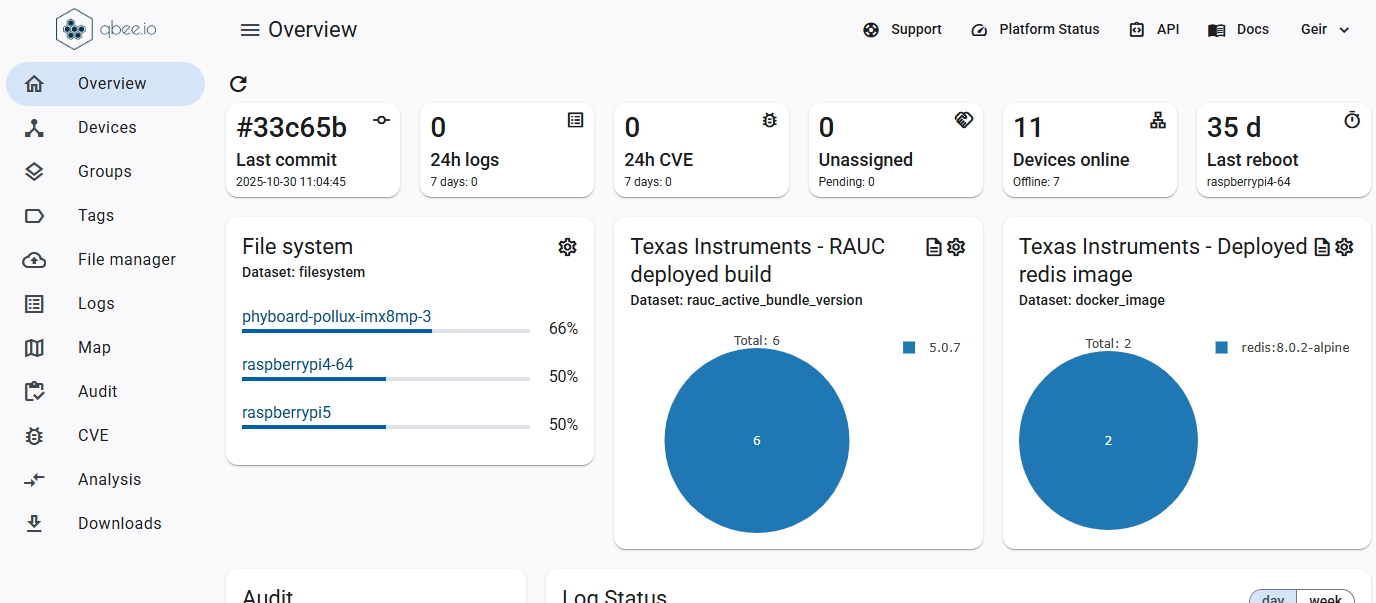
Security requires continuous visibility into device health, security posture, configuration drift, and operational status. Runtime monitoring, audit trails, anomaly detection, vulnerability tracking, and remote remediation capabilities are becoming essential components of a modern IoT product strategy. Security is evolving from a point-in-time activity into an ongoing operational discipline.
As IoT products continue to evolve, the central question facing manufacturers is, "How do we ensure our devices remain secure, compliant, and maintainable throughout their entire lifecycle?" The companies that answer that question successfully will be the ones best positioned to build trusted connected products in the years ahead.
.png)