%20(1).svg)
.png)

Over-the-air (OTA) software updates have evolved from a maintenance capability into a foundational pillar of modern IoT and edge operations. As embedded systems become more intelligent—running edge AI, autonomous agents, containerized workloads, and increasingly modular software stacks—the ability to securely deploy, orchestrate, and manage software at scale has become a core enterprise requirement.
Today's connected devices require far more than operating system or firmware updates. Engineering teams must manage an increasingly complex software supply chain spanning operating system components, applications, containers, AI inference services, machine learning models, configuration changes, and security patches. Delivering each of these reliably across thousands—or millions—of distributed devices requires an OTA strategy that extends well beyond traditional firmware management.
The challenge is that not all OTA platforms are designed for the same purpose.
Some specialize in firmware updates. Others focus on application deployment, container orchestration, or AI model distribution. Some depend on tightly coupled, proprietary update frameworks that limit architectural flexibility and complicate future evolution. Selecting the wrong platform can result in fragmented deployment workflows, costly architectural redesigns, vendor lock-in, and growing operational complexity as device fleets expand.
This guide explores the technical capabilities engineering leaders should evaluate when selecting an OTA platform—one that not only supports today's embedded Linux and IoT software lifecycle, but is also designed for the next generation of intelligent edge systems powered by AI, agentic applications, and continuous software and model delivery.
The first question isn't which OTA platform to buy—it's what software layer you need to update. Modern embedded Linux devices typically consist of multiple software layers as shown in the figure below.
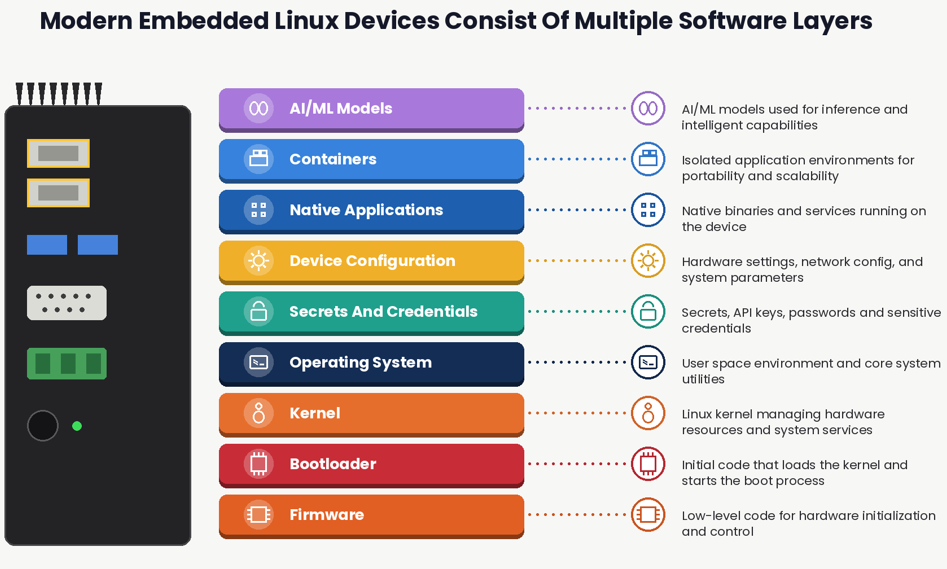
Each layer has different update requirements. For example:
A capable OTA solution should support multiple deployment types instead of treating every update like a full operating system replacement.
One of the biggest mistakes organizations make is using firmware updates for everything. Updating an entire operating system image just to release a new application version increases deployment time, download size, device downtime, rollback complexity, and network costs.
Instead of treating every software component the same, mature edge management platforms separate system updates from application updates. System updates are reserved for foundational device software—including Linux distributions, kernel updates, security patches, device drivers, and bootloader updates—and require atomic installation with reliable rollback mechanisms to ensure devices remain operational if an update fails. Application updates, on the other hand, focus on the software running on top of the operating system, such as containers, native applications, Python services, AI inference engines, and configuration files. By managing these update workflows independently, organizations can deploy applications more frequently while minimizing the risk and complexity associated with updating the underlying operating system.
The most operationally efficient platforms allow organizations to manage both system and application updates through a unified control plane while keeping each lifecycle independent.
Learn More: The Guide to Secure and Scalable Over-the-Air (OTA) Updates for IoT Infrastructure
Few organizations manage identical hardware forever. As IoT infrastructure deployments grow, device fleets inevitably become more diverse. Organizations often end up managing multiple CPU architectures, different Linux distributions, hardware from various vendors, several generations of software, and a mix of update mechanisms.
Today's IoT and edge-to-cloud management platforms increasingly include OTA software update capabilities as part of a broader infrastructure lifecycle management solution. However, they differ significantly in their architectural philosophy. Some are tightly coupled to a specific OTA update framework or operating model, while others are purpose-built around proprietary workflows. At the other end of the spectrum, general-purpose cloud IoT platforms provide OTA functionality as one feature among many, often requiring additional integration work to support production-grade software delivery. Understanding these architectural trade-offs is essential when selecting a platform that can evolve with your products and deployment requirements.
When selecting an IoT platform, organizations should evaluate whether the platform complements their existing investments or requires them to adopt a new update architecture. This distinction becomes increasingly important as production fleets grow, hardware diversity increases, and devices remain operational for many years
Replacing an existing OTA update architecture after deployment is rarely practical. A migration can require significant engineering effort, including bootloader redesign, storage layout changes, manufacturing process updates, extensive regression testing, and device recertification.
A flexible IoT platform should support the update needs of organizations whether based on available open-source frameworks or in-house custom built solutions. The goal is not simply to deliver software updates, but to provide a unified operational layer that enables secure deployments, fleet visibility, automation, and lifecycle management without forcing unnecessary architectural changes.
This is where architectural flexibility becomes a critical selection criterion. Qbee.io takes a framework-agnostic approach by integrating with existing OTA update mechanisms rather than replacing them. By supporting heterogeneous Linux fleets across different hardware vendors, architectures, operating systems, and update strategies, Qbee enables organizations to preserve their engineering investments while gaining centralized control over device operations.
There is no universally "best" OTA framework—only the one that best fits your product architecture and fleet operational requirements.
Learn More: OTA Best Practices Checklist
OTA software updates should be viewed as a core component of your device security infrastructure—not simply a mechanism for delivering new features or bug fixes. Every update that reaches a device represents a potential trust decision, making security fundamental to the entire update process.
A secure OTA strategy starts by ensuring that every software package is authentic. Update artifacts should be cryptographically signed during the build process, and every device should verify those signatures before installing new software. Without this validation, there is no guarantee that the software originated from a trusted source or hasn't been tampered with in transit.
The communication channel used to deliver updates must also be protected. All OTA traffic should be encrypted using TLS, while mutual TLS (mTLS) provides an additional layer of security by allowing both the device and the server to authenticate each other before any software is exchanged.
Strong device identity is equally important. Hardware-backed identities or unique device certificates enable each device to prove its identity before interacting with the OTA infrastructure, preventing unauthorized or counterfeit devices from joining the fleet.
Finally, the trust established during software delivery must extend through the device boot process. Technologies such as Secure Boot, Verified Boot, and Measured Boot ensure that only trusted software is executed, helping prevent compromised firmware or operating systems from running even if an attacker gains access to the device.
The most effective OTA platforms don't attempt to replace these security mechanisms—they integrate seamlessly with them. Rather than treating security as an optional feature, they make it an integral part of the software supply chain, from image creation and deployment to device authentication and runtime integrity.
Learn More: Design Considerations for Secure OTA Updates in an Embedded Linux Environment
An effective OTA strategy functions as a seamless extension of the continuous delivery pipeline, bridging the gap between cloud-based development and physical edge assets. Rather than operating as an isolated utility, a mature OTA-capable platform integrates directly with established DevOps and MLOps toolchains to orchestrate the automated flow of system firmware, containerized workloads, ML inference engines, and sophisticated edge AI models. By minimizing manual touchpoints throughout the promotion lifecycle, organizations can ensure that every software release adheres to a standardized, secure, and fully auditable workflow—accelerating deployment velocity while significantly mitigating the operational risks inherent in large-scale fleet management.
In this context, the OTA-capable platform serves as the critical deployment conduit, providing the reliability and security necessary to distribute these advanced digital artifacts across thousands of distributed devices in the field.
As depicted in the figure below, every change moves through the same disciplined stages before it reaches a device. OTA’s role begins once artifacts are built, packaged and signed, taking over continuous delivery (CD) and stages of product release.
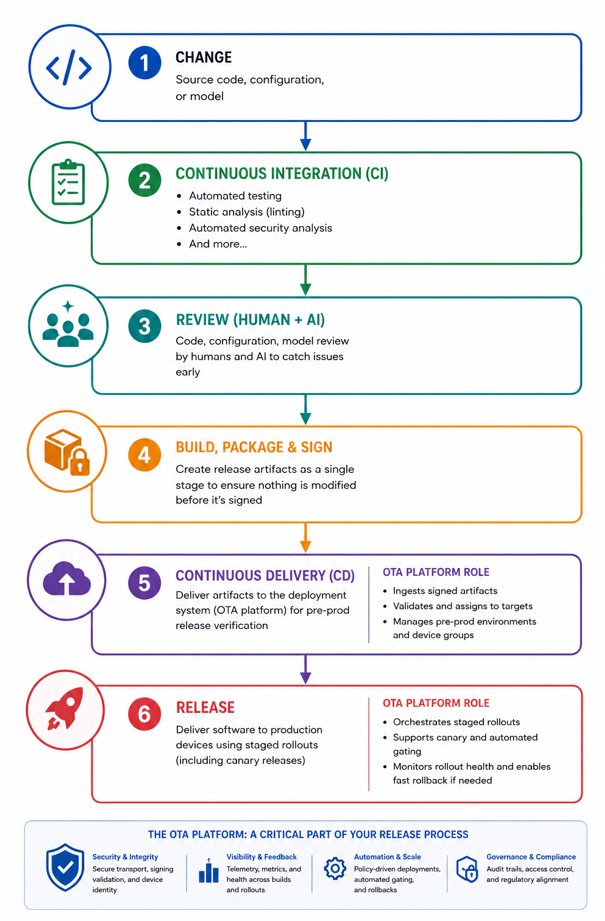
Once artifacts are signed, the OTA capable platform owns delivery and release, pushing verified builds through pre-production checks and into a staged, canary-aware rollout across the production fleet.
Many organizations initially purchase or build a homegrown OTA solution solely for software deployment. Over time they realize managing distributed devices requires much more. Consider whether the platform also provides:
Combining these capabilities into a unified management platform reduces operational complexity and minimizes the need for multiple disconnected tools.
Qbee enables enterprises to transition from basic device updates to the reliable operation of large-scale IoT devices and intelligent edge fleets. By separating infrastructure management from the underlying update mechanisms, the platform allows organizations to protect their engineering investments and select the optimal OTA strategy for every hardware profile. This framework-agnostic approach provides a unified operational layer for managing increasingly heterogeneous IoT and edge infrastructure through a centralized control plane.
When evaluating whether to engineer a custom IoT infrastructure or adopt a commercial platform with integrated OTA capabilities, the subscription fee is rarely the most significant cost driver. A build-your-own approach requires accounting for far more than simple update delivery; it necessitates significant upfront investment in integration effort, bootloader modifications, and device-side engineering to achieve baseline functionality.
Beyond the initial development phase, organizations must absorb the long-term responsibility for managing hosting infrastructure, and continuous system maintenance. This is compounded by the ongoing operational overhead of fleet monitoring, the complex burden of security compliance, and the internal resources required for team training and support. Furthermore, engineering leaders must weigh the strategic risk of technical debt against the potential for vendor lock-in. While commercial IoT platforms involve recurring costs, they often represent a lower total cost of ownership when measured against the full engineering lifecycle of building and sustaining a production-grade internal system.
Many organizations encounter avoidable challenges when evaluating OTA platforms. Common pitfalls include:
Avoiding these mistakes early can save significant engineering effort as fleets grow and software complexity increases.
As embedded devices become more software-defined, OTA updates are evolving into just one capability within a broader IoT devices and edge operations strategy. Engineering teams increasingly need platforms that can do more such as manage configurations, monitor, access and troubleshoot devices remotely, enforce security policies, and support continuous operations across diverse fleets.
The most effective OTA solutions do more than deliver software. They integrate with existing update frameworks, support independent system and application lifecycles, enable secure deployments, automate fleet orchestration, and fit naturally into modern DevOps and MLOps workflows.
As connected products become more software-defined, the right OTA platform becomes a strategic investment in reliability, security, and operational scalability. Choosing a solution that aligns with your architecture today—and can evolve with your fleet tomorrow—will pay dividends throughout the life of your devices.
.png)