%20(1).svg)
%20(1255%20x%20592%20px).png)

Managing a handful of connected hardware prototypes on a laboratory workbench is a rewarding engineering task. Managing ten thousand of those same devices—deployed across unpredictable cellular networks, unreliable power, varying hardware environments, and remote customer sites—is an entirely different operational reality.
For modern IoT infrastructure teams, the old paradigm of isolated firmware flashing is dead. Today’s edge fleets span a vast architectural spectrum: from high-performance gateways running fully fledged operating systems like Linux, to resource-constrained microcontrollers (MCUs) running Real-Time Operating Systems (RTOS) or bare-metal applications.
To maintain fleet health, protect data integrity, and push new software features without risking catastrophic field-bricking incidents, engineering teams require a mature, adaptable Over-the-Air (OTA) update and configuration management framework.
This playbook provides the strategic blueprint for building a production-grade, secure, and failsafe OTA mechanism for IoT and edge computing devices, mapping technical execution directly to enterprise operational metric
When an IoT fleet scales past a few hundred devices, manual software updates and operational maintenance of these devices become impossible. Engineering leaders face a distinct operational paradox: the product team demands rapid feature velocity to stay competitive, while the platform and security teams demand absolute system stability. The hidden bottlenecks of scale can be broken down into the following core categories:
Relying on home-grown update scripts, manual SSH loops, or generic IT configuration tools in the market create significant technical debt. True operational scale demands a unified client-server device management and OTA-capable platform specifically engineered for resource-constrained embedded environments.
Learn more: The State of IoT Security and Compliance in 2026
Building a production-ready Over-the-Air (OTA) update pipeline requires more than just pushing a file over the internet. It demands a highly orchestrated, multi-layered architecture where security, scalability, and device resilience work in perfect harmony. To understand how a modern OTA process functions, we can break it down into three core pillars: the cloud backend, the delivery pipeline, and the edge device.
Secure OTA updates require encrypted communication pipelines that stretch from the central cloud down to the constrained device layer. Because updates must traverse intermediate gateways in the edge compute layer to reach remote hardware like sensors and robots, securing the entire deployment workflow is critical. Mitigating vulnerabilities across these highly distributed edge computing environments is the only way to prevent malicious firmware tampering, ensuring continuous device cybersecurity, physical safety, and strict regulatory compliance.
Learn more: OTA Best Practices Checklist
IoT software updates vary by industry, product type, and lifecycle phase to align with evolving end-user value. Over a device's lifespan, updates shift from early feature enhancements to long-term security maintenance. Tailoring these rollouts to the product's specific lifecycle stage ensures continuous operational value and regulatory compliance without disrupting the user experience. To address these varying needs, fleet software updates are broadly divided into two categories: system updates and application updates.
Core Operating System Updates (Dual-Root A/B)
For low-level system updates, kernel patches, or critical security hardening, the standard industry practice is Dual-Root (A/B) Partitioning.
The device maintains two separate root filesystem partitions. The active system runs on Partition A, while the OTA agent writes the new operating system image to Partition B in the background. Once the download is cryptographically verified, the bootloader (such as U-Boot or GRUB) flips a flag to boot into Partition B upon the next restart.
System-level updates are highly robust and atomic, ensuring devices either complete the update successfully or remain on a known working version without ending up in a broken state. By maintaining a fallback partition, devices can automatically reboot into the previous stable image if an update fails, significantly reducing the risk of device bricking and improving operational reliability.
The primary drawback of system updates is the increased hardware cost associated with maintaining dual storage partitions, which effectively requires additional onboard storage capacity. Other challenges are that a system reboot is required after full installation and that it can also consume massive bandwidth if the update framework does not have a mechanism to handle differential system updates. This can significantly increase update times and drive higher connectivity costs over cellular networks. As a result, system updates are generally less suited for continuous or high-frequency deployments, where frequent data transfers can become operationally expensive and disruptive.
Application Updates
Application updates typically target components higher up in the software stack, such as user interface applications, middleware, or cloud connectivity clients. These updates can take many forms, ranging from simple file replacements to package, and container updates depending on the device architecture and deployment model.
For application-level changes, microservices, or updating AI/ML model weights, teams utilize containerization (Docker) or localized package management. This allows software engineers to hot-swap application code or adjust configuration files smoothly without interrupting core system uptime.
Application updates are typically much smaller in size, faster to deploy, and more cost-effective than full system updates. As a result, they are better suited for use cases that require frequent software releases or operate in environments where bandwidth consumption and network connectivity costs—such as cellular data—are important considerations.
The primary drawback of application updates is the increased risk of rendering a device unusable if something goes wrong during deployment. Even seemingly minor changes—such as a small configuration update—can have significant consequences if they disrupt critical functionality. Even container-based deployments are not immune, as issues with the underlying container runtime or orchestration layer can still lead to device failures if not handled properly.
Learn More: Design Considerations for Secure OTA Updates in an Embedded Linux Environment
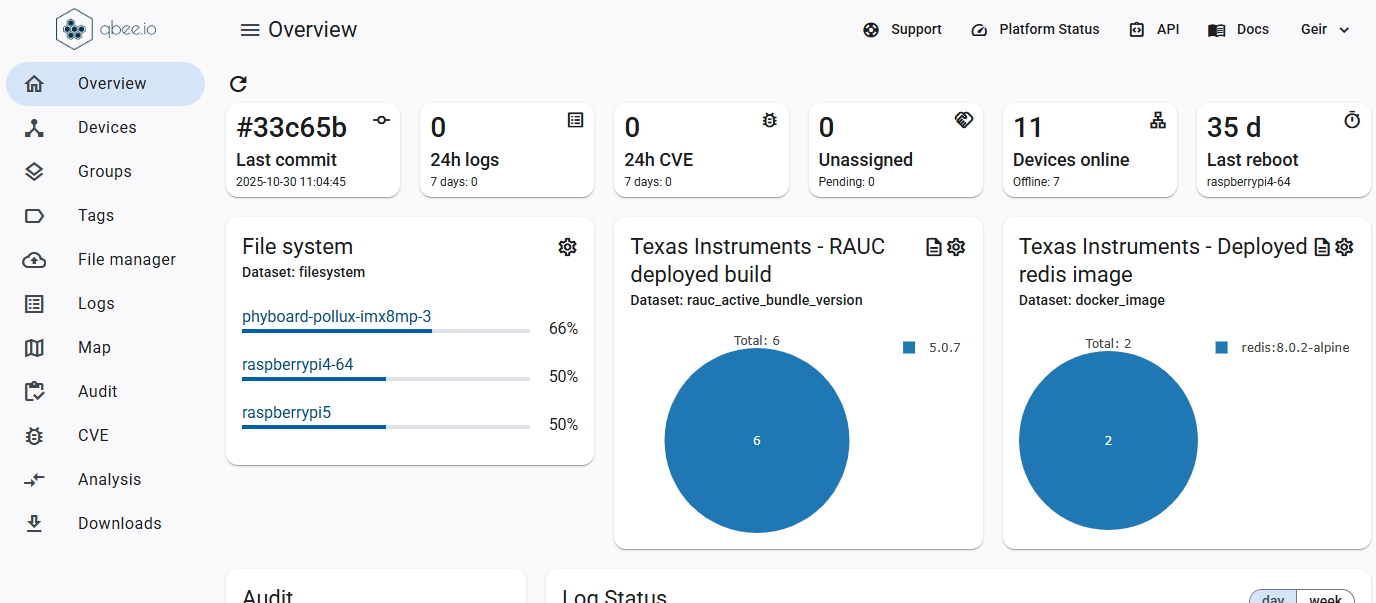
The Qbee approach to OTA is built around flexibility, control, and long-term scalability—helping organizations reduce operational complexity and risk across diverse device fleets. Rather than relying on a rigid, image-based operating system lifecycle framework, Qbee enables teams to manage software updates in the way that best fits their infrastructure. This gives organizations the agility to scale heterogeneous device fleets without being locked into a one-size-fits-all OTA model.
Whether devices rely on open-source OTA frameworks such as RAUC, or SWUpdate—or proprietary in-house solutions for robust, atomic, failsafe A/B system image updates—Qbee provides a unified control plane to orchestrate software delivery across distributed Linux and embedded device fleets. In addition, Qbee includes native support for application-level updates out of the box, enabling teams to manage both system and application software from a single platform.
This flexibility is particularly valuable for organizations operating heterogeneous device environments, where different products, hardware architectures, or business units often rely on different update strategies. In the real world, fleets are rarely uniform—an AI edge appliance may run container-based updates, an industrial gateway may require A/B firmware updates through RAUC, while another product line may already be standardized on Mender. Rather than forcing costly migrations or fragmented tooling, Qbee enables teams to manage these diverse environments through a single operational platform, reducing cost and complexity.
The Qbee approach is also well-suited for modern intelligent edge and physical AI systems, where applications, AI models, containers, and configurations evolve much faster than the underlying operating system. In many edge deployments, organizations need to continuously update workloads without rebuilding or redeploying entire OS images. Qbee supports this operational model by enabling application, container, package, and configuration updates alongside full OTA workflows, allowing teams to iterate faster while maintaining operational consistency.
Learn More: A Practical Guide to Choosing an OTA Software Update Solution for IoT
Many teams treat OTA updates as a pure file-delivery problem. In reality, an update mechanism is only as secure as the device management environment surrounding it. Pushing signed, encrypted payloads is a baseline requirement, but true device security requires a proactive, multi-layered posture.
A common architectural error is building a "Frankenstein" architecture: using one tool for file distribution, another standalone daemon for metrics collection, and an open-source VPN client for remote access. This tool sprawl introduces significant vulnerabilities:
True security compliance demands that configuration management, vulnerability scanning, and remote diagnostics live inside a single, hardened orchestration plane.
Ultimately, Qbee helps organizations move beyond simply updating devices to operating IoT and intelligent edge fleets at scale reliably. By decoupling fleet management from the update engine, Qbee gives enterprises the freedom to preserve existing investments, adopt the right OTA technology for each device, and unify operations across increasingly complex IoT and edge infrastructure—all through a single platform.
.png)